

i3C BRIC-RCB Ph.D. Programme in Biosciences Structure, Courses, and Internships

- What is the i3C BRIC-RCB Ph.D. Programme in Biosciences?
- i3C BRIC-RCB Ph.D. Programme in Biosciences Structure
- Coursework in i3C BRIC-RCB Ph.D. Programme in Biosciences
- Subjects and Courses Covered
- Molecular Biology and Genetics
- Cell Biology and Immunology
- Computational and Systems Biology
- Biotechnology and Translational Research
- Advanced Technology Platform Training
- Internship and Immersion Programme
- Research Institutions Under the Programme
- Eligibility for i3C BRIC-RCB Ph.D. Programme in Biosciences
- Track I
- Track II
- Selection Process
- Why the i3C BRIC-RCB Ph.D. Programme is Different
- Career Opportunities After the Programme
- Final Thoughts
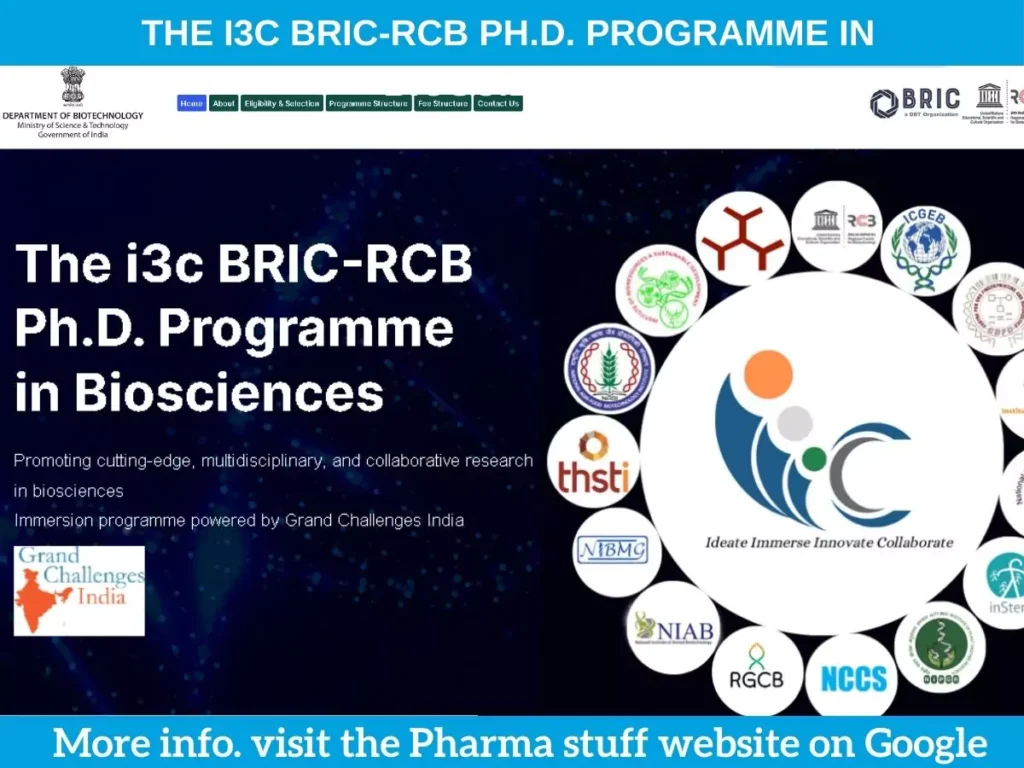
The i3C BRIC-RCB Ph.D. Programme in Biosciences is one of India’s most ambitious interdisciplinary doctoral programmes designed to train the next generation of bioscience researchers through collaborative learning, advanced coursework, and industry-oriented immersion programs. The programme is jointly offered by the Biotechnology Research and Innovation Council (BRIC), Regional Centre for Biotechnology (RCB), and BRIC+ institutions including ICGEB and other premier DBT institutes.
The programme focuses on creating globally competitive researchers capable of solving complex biological and healthcare challenges through innovation, collaboration, and cutting-edge science. Unlike conventional Ph.D. programs that begin directly with laboratory research, the i3C BRIC-RCB Ph.D. Programme in Biosciences follows a structured academic model combining foundational training, interdisciplinary coursework, immersion internships, and collaborative research exposure.
What is the i3C BRIC-RCB Ph.D. Programme in Biosciences?
The i3C BRIC-RCB Ph.D. Programme in Biosciences was established to strengthen interdisciplinary bioscience education in India and promote collaborative research among BRIC institutions, RCB, and ICGEB. The programme is specifically designed to produce highly skilled scientists capable of working across biotechnology, healthcare, computational biology, biomedical sciences, agriculture, engineering, and translational research domains.
The full form of i3C stands for:
- Ideate
- Immerse
- Innovate
- Collaborate
This framework forms the foundation of the programme structure and learning methodology.
i3C BRIC-RCB Ph.D. Programme in Biosciences Structure
One of the biggest highlights of the i3C BRIC-RCB Ph.D. Programme in Biosciences Structure, Courses, and Internships is its carefully designed multi-stage training system.
The programme includes:
- Foundational coursework at RCB
- Technology platform training
- Field immersion internship
- Research placement at BRIC+ institutions
- Collaborative interdisciplinary Ph.D. research
According to the official programme notification, all selected scholars undergo one semester of physical coursework at Regional Centre for Biotechnology (RCB), Faridabad immediately after admission.
After completion of coursework, students participate in a three-month immersion programme before joining their allotted BRIC+ institution for the remaining Ph.D. research duration.
This structure is significantly different from traditional Ph.D. admission models in India because students receive formal interdisciplinary scientific training before entering research laboratories.
Coursework in i3C BRIC-RCB Ph.D. Programme in Biosciences
The coursework component is one of the strongest aspects of the i3C BRIC-RCB Ph.D. Programme in Biosciences Structure, Courses, and Internships.
The coursework lasts approximately six months and is conducted physically at RCB Faridabad. During this period, students receive exposure to advanced bioscience subjects, interdisciplinary research methodologies, and high-end technology platforms.
The programme advertisement clearly mentions:
- Cross-disciplinary research programme
- Foundational coursework
- Training on high-end technology platforms
- Large collaborative research teams
- Exposure to cutting-edge scientific areas
Subjects and Courses Covered
Although the exact semester syllabus may vary based on faculty and institutional collaborations, the coursework generally focuses on the following domains:
Molecular Biology and Genetics
Students receive advanced conceptual and practical training in:
- Molecular genetics
- Recombinant DNA technology
- Gene expression
- CRISPR and genome engineering
- Functional genomics
Cell Biology and Immunology
Core modules may include:
- Cell signaling
- Stem cell biology
- Cancer biology
- Host-pathogen interaction
- Immunotechnology
Computational and Systems Biology
A major strength of the programme is interdisciplinary integration. Students may receive training in:
- Bioinformatics
- Artificial intelligence in biology
- Systems biology
- Data science for biosciences
- Computational genomics
Biotechnology and Translational Research
The programme strongly emphasizes translational science through courses involving:
- Drug discovery
- Vaccine development
- Diagnostics
- Industrial biotechnology
- Precision medicine
Advanced Technology Platform Training
Students are trained on sophisticated research platforms such as:
- Next-generation sequencing
- Flow cytometry
- Confocal microscopy
- Proteomics
- Metabolomics
- High-throughput screening
- Structural biology tools
This technology-focused training makes the i3C BRIC-RCB Ph.D. Programme in Biosciences Structure, Courses, and Internships highly industry-relevant compared to conventional Ph.D. programs.
Internship and Immersion Programme
The internship component is another defining feature of the programme.
After coursework completion, scholars undergo a three-month immersion programme funded by Grand Challenges India.
The immersion programme is designed to expose students to:
- Real-world scientific problems
- Translational research ecosystems
- Startup innovation models
- Public health challenges
- Industry-academia collaboration
Students may work in:
- Research laboratories
- Biotechnology startups
- Clinical research environments
- Public health organizations
- Innovation incubators
This immersion phase bridges the gap between academic research and real-world biotechnology applications.
Research Institutions Under the Programme
Students admitted through the i3C BRIC-RCB Ph.D. Programme in Biosciences can pursue research in BRIC institutions, RCB, and ICGEB based on merit and selection preferences.
Participating institutes include:
- Regional Centre for Biotechnology (RCB)
- International Centre for Genetic Engineering and Biotechnology (ICGEB)
- National Institute of Immunology (NII)
- Translational Health Science and Technology Institute (THSTI)
- National Agri-Food Biotechnology Institute (NABI)
- Institute of Bioresources and Sustainable Development (IBSD)
- Centre for DNA Fingerprinting and Diagnostics (CDFD)
- Rajiv Gandhi Centre for Biotechnology (RGCB)
- National Institute of Biomedical Genomics (NIBMG)
- National Institute of Animal Biotechnology (NIAB)
- National Centre for Cell Science (NCCS)
- inStem
- Other BRIC-associated institutions
This multi-institution model significantly expands research networking and collaborative opportunities.
Eligibility for i3C BRIC-RCB Ph.D. Programme in Biosciences
The programme offers two admission tracks.
Track I
Eligible candidates include students with:
- MSc
- MTech
- MBBS
- MPharm
- MVSc
- Four-year Bachelor’s degree in science and technology disciplines
Candidates must possess a valid national fellowship such as:
- DBT-JRF
- CSIR-JRF
- UGC-JRF
- ICMR-JRF
Track II
Track II is designed for students from:
- Non-biological engineering branches
- MBBS background
No prior national fellowship is required for Track II applicants.
Selection Process
The selection process for the i3C BRIC-RCB Ph.D. Programme in Biosciences includes:
- Online application submission
- First online interview
- Second in-person interview at RCB
- Interaction with BRIC+ institution representatives
- Final institute allocation
The programme strongly evaluates:
- Scientific aptitude
- Interdisciplinary thinking
- Research interest
- Problem-solving capability
- Communication skills
Why the i3C BRIC-RCB Ph.D. Programme is Different
Most Indian Ph.D. programs directly assign students to laboratories with minimal formal training. The i3C BRIC-RCB Ph.D. Programme in Biosciences Structure, Courses, and Internships is different because it emphasizes:
- Structured interdisciplinary education
- Multi-institution collaboration
- Technology training
- Scientific immersion
- Translational exposure
- Collaborative research ecosystems
This model resembles modern international Ph.D. training frameworks followed by leading global universities.
Career Opportunities After the Programme
Graduates from the programme may pursue careers in:
- Academic research
- Biotechnology industry
- Pharmaceutical R&D
- Genomics companies
- Computational biology
- Clinical research
- Healthcare innovation
- Startup ecosystem
- Government scientific organizations
The interdisciplinary exposure and advanced platform training significantly improve employability in both academic and industrial sectors.
Final Thoughts
The i3C BRIC-RCB Ph.D. Programme in Biosciences Structure, Courses, and Internships represents a major shift in bioscience doctoral education in India. The programme combines rigorous coursework, interdisciplinary research, technology platform exposure, collaborative mentoring, and real-world immersion experiences.


Responses